
|
The Centre for Social Impact Academic Excellence fit for Social Purpose
CSI Update, Issue 2, June 2008

Message from the CEO
In the fleeting weeks since our last newsletter a great deal has happened. From my experience, setting up a new national institution is equal parts frustration and exhilaration. It's often only when I pause to reflect that I realize how much has been achieved.
A big thanks to all those who participated in the Focus Groups in Melbourne, Sydney and Canberra. Unfortunately, due to an unforeseen occurrence (which involved placing my body in a foolhardy manner between a wild cat and an angry dog) I missed the Melbourne workshops, instead visiting one of Australia's great not-for-profit institutions, the Royal Prince Alfred Hospital. I read the detailed notes kept by Vijoleta and Danielle and attended the other workshops.
A full report is attached in this newsletter. From my perspective it was an invigorating opportunity to get feedback first-hand on the Centre's aspirations, strategy and goals. This was not just a listening tour. Participants will see that the final business plan is markedly different from the draft I circulated for comment - different and decidedly better. Best of all, the Plan has now been accepted by the Australian Government for the purposes of parting with $12.5m to establish the Centre's endowment fund by the middle of this month.
This Friday the 13th brings good fortune in the shape of a move into our new, custom-designed offices in the Australian School of Business building. I hope that in the months ahead, many of you will visit us there. We will certainly make you welcome.
I am delighted that, to celebrate our move and to formally launch the Centre, Their Excellencies, Major-General Michael Jeffery and Mrs Marlena Jeffery, will join us for tea on 15th July. It will be a small, by-invitation event to share our appreciation with at least some of you who have offered us such wonderful support in our first three months.
The beginning has begun.
Please feel free to contact me at csi@unsw.edu.au.
Peter Shergold, Chief Executive.
________________________________________
CEO dinner
On May 6, the Centre hosted the first in a planned series of dinners for not-for-profit leaders and corporate executives at the University of New South Wales' O'Connell St campus in the Sydney CBD. The next dinner will be held in Melbourne in the near future. It was an opportunity for a wide-ranging conversation about issues facing the not-for-profit sector and what role CSI might play in helping to address them. A looser format helped fill out the picture from the more structured focus groups. It was clear from the lively discussion that not-for-profits face shared challenges, such as how to hold onto management talent tempted by higher salaries outside the sector, how to measure returns on social investment and how to be heard by government on issues of profound importance to the sector's daily work, from the overall policy framework to methods of service delivery. For more detailed discussion of the issues raised in the focus groups and at the dinner, click here. It was also clear that CSI can play a valuable role as a neutral meeting place where diverse participants can engage in open and robust discussions generating new ideas, collaborative approaches and enhanced cohesion in the sector.
Feedback was that the conversation was "outstanding" and "very stimulating with some good ideas generated". There was enthusiasm for further such meetings. The Sydney participants were Peter Hunt, Caliburn Partnership; Greg Hutchinson, deputy chairman, Australian Charities Fund, Bain and Company; Jack Heath, Founder Inspire Foundation; Sue Murray, National Breast Cancer Foundation; Doug Taylor, United Way; Michael Traill, Social Ventures Australia; Keith Garner, Wesley Mission; Elaine Henry, The Smith Family; Robert Tickner, Red Cross; Dawn O'Neill, Lifeline Australia; Richard Spencer, Benevolent Society; Peter Kell, Anglicare; Doug Snedden, Accenture; Mary Jo Capps, Musica Viva; Martine Letts, Lowy Institute; Ann Sherry, Carnival; Toby Hall, Mission Australia; Doug Jukes, KPMG and Peter Shergold, Anne Measday and Vijoleta Braach Maksvytis from the Centre for Social Impact.
Appointments
Advertisements for the positions of Director of Teaching and Learning and Director of Research attracted a wide field from within Australia and overseas. Applications have closed and interviews will be held on July 10. The selection panels will include representatives of the three partner business schools and of not-for-profit organisations.
Chris Norgrove joins the Centre as an Executive Assistant. She brings extensive experience from the corporate sector, previously working as an Executive Assistant with KBR, Sydney IVF Limited, HRM Consulting Pty Ltd and Brisbane City Travelodge. Chris has also completed an advanced Certificate in Travel and is a qualified International Travel Consultant.
Lisa Lusthaus works part time as the Centre's Secretariat Officer. She has completed a Bachelor of Science, Applied Psychology (Honours) from the University of New South Wales. She began her career as a research psychologist at The Royal Alexandra Hospital for Children, working in the Child Safety Centre on child accident prevention. She also worked with "David and the Helping Hand" Child Safety health program and has published articles on child safety. She founded MicroPress, a news bulletin specially written for children to encourage them to read about current affairs.
Eva Burns has recently left the Centre to take up the position of Executive Assistant/Administrator to Chris Adam and Simon Arnold in the Australian School of Business. We thank Eva for her help in the establishment of the Centre.
Governance
Representatives of the three CSI business school partners (MBS, Swinburne and AGSM) met in Sydney in May and will meet in Melbourne on June 13 to discuss development of CSI courses and executive education programs in the three universities. The first meeting of the CSI governing board including the three partner university Vice-Chancellors (Fred Hilmer UNSW, Glyn Davis Melbourne and Ian Young, Swinburne) and representatives from the not-for-profit and corporate sectors was held this week.
Advisory councils are being established in Sydney and Melbourne, each with membership of about 30 drawn from not-for-profits, philanthropic foundations and the corporate and government sector. They will meet by September and thereafter, about three times a year. Their role will be to advise the Centre on research priorities, public policy issues and executive programs and at the same time to particularly help the Centre in identifying opportunities for on-the-job learning for its students. Lisa Lusthaus will provide Secretariat support from CSI.
Executive programs
The Centre is planning an exciting suite of workshops and seminars on topics raised by the forum groups starting in the second half of this year. They will be held in both Melbourne and Sydney. A full program is planned for 2009.
Among the local and international experts engaged for 2008 are: John Casey, Associate Professor, School of Public Affairs, Baruch College, City University of New York. In August he will conduct a workshop on the creation of national compacts between governments and not-for-profit organisations. This workshop will also involve Bronwen Dalton from the School of Management at UTS and Karen Grogan of SACOSS. John Casey will also conduct a seminar on maintaining integrity in the third sector.
Andrew Kakabadse, Professor of International Management Development, Cranfield School of Management and Nada Kakabadse, Professor in Management and Business Research at the University of Northampton Business School. In August they will run a short program on how to relate CSR to strategic organisational goals. Andrew will also address Board members on his recent research about directors' attitudes towards CSR.
Goran Roos, founder, Intellectual Capital Services. Goran is a visiting professor at Helsinki School of Economics Centre for Executive Education and also at Cranfield School of Management. He is a renowned expert in measuring the return on social investment and will run a workshop on this topic in November.
Paul ‘t Hart, Professor in the Political Science program at the Australian National University. Paul will run a course on issues of leadership focusing on the relationship between governments and not-for-profits.
If would like to receive further information about these events, or other courses we will run, please register your interest by using the form attached to this email.
UN Global Compact
CSI has joined the UN Global Compact. This commits us to the Compact's ten principles of responsible business practice in the areas of human rights, anti-corruption, the environment, and labour rights and to helping achieve the UN's Millennium Development Goals. CSI looks forward to being involved in the Compact's policy dialogues and sharing resources, skills and experience with the UN and the Compact's other government, business and civil society members.
Website
Work on the CSI website is proceeding with a view to getting it up and running by the end of July. It will promote the Centre's aims and activities and engage the CSI community - social enterprises, corporates, philanthropic foundations, government agencies and universities - with regular updates on news and events and useful links. Ultimately we aim to provide an Australian clearing house for news and information from around the world on ideas and developments in social enterprise and innovation.
CSI backs AGSM team in China challenge
CSI proudly sponsored three students from the Australian Graduate School of Management (AGSM) to travel to Shanghai to participate in the Innovate China competition run by the China Europe International Business School. MBA students from business schools around the world participated in this year's challenge under the theme of Corporate Social Responsibility. Schools' teams have a choice of actual dilemmas drawn from the Chinese business community to create sustainable social enterprise solutions that will make a positive impact.
Team AGSM qualified as one of the top teams from round one with their report on sustainable social enterprises to benefit Chinese urban poor. They flew to China early this month to join other finalists participating in the Grand Challenge in Shanghai We eagerly await news of the results.
Forum groups feedback
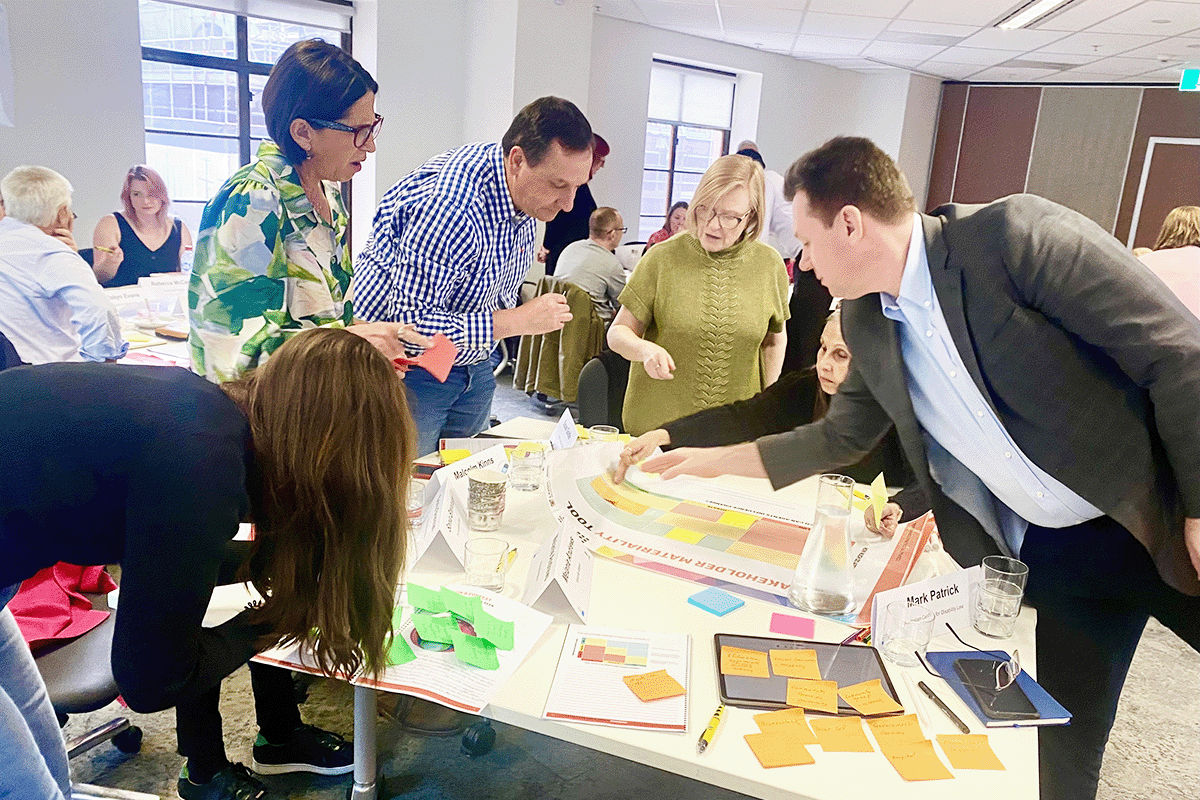
CSI organised a series of five focus groups in Melbourne, Sydney and Canberra in April 2008. The meetings were facilitated by Richard Fleming, Michael Woodbury and Chris Yoo of Bain and Company. Peter Shergold, Vijoleta Braach-Maksvytis and Danielle Begg attended from CSI. Following the focus groups, a working dinner was held with not-for-profit leaders and corporate executives in Sydney. What follows is feedback from these open and robust discussions which have shaped thinking about the Centre's role. The views of those who have emailed comments on the first draft of the Centre's planning framework have also been taken into account.
The issues that dominated focus groups varied. Given the calibre, diversity and experience of those attending, there were inevitably disagreements and differences of perspective. Nevertheless, a number of key messages were shared to varying degrees by most participants.
Enhance capacity, not ‘fix' the sector: A recurring strong concern was that the role of the Centre not be characterised as ‘fixing' not-for-profit organisations, or ‘smartening them up' or ‘cleaning up the third sector'.
It was accepted that the operating environment of social enterprises had changed significantly in the last decade. The private sector, increasingly espousing ‘social responsibility', ‘sustainability' or ‘corporate citizenship' is now providing donations based on expectations of social returns from the investment rather than traditional philanthropy. Governments, whose funding of not-for-profit businesses is growing in significance, are now more likely to enter into contracts for the delivery of public services than to provide community grants.
There was strong support for acknowledging the significance of not-for-profits in the teaching of socially responsible business administration. Conversely there was general recognition that the Centre's business-oriented teaching and research could enhance the organisational capacity of social enterprises.
Most focus group participants argued strongly that the effectiveness and professionalism of not-for-profit management was not simply a matter of applying market mechanisms and a corporate ethos to community-based organisations. They noted that social enterprises, driven by values of the heart, face particular and distinctive challenges. They need to harness voluntary effort, operate flat management structures, raise funds, retain employees on the basis of mission rather than remuneration and work to and with multiple stakeholders - all of this without compromising organisational goals. It was, many participants believed, a balancing act at least as difficult as safeguarding the interests of shareholders in the corporate sector. Participants wanted the achievements of many not-for-profits in turning these obstacles into opportunities to be acknowledged and respected.
Some participants were concerned that the Centre's strategic direction might be couched in terms that could be read as patronising. It was considered important that the Centre explicitly recognise the existing skills and dedication of social enterprises. The role of the Centre should be couched in terms of strengthening - not creating - capacity. The Centre should articulate its purpose not as ‘helping' not-for-profits to improve their effectiveness but as providing a rigorous learning structure within which their existing capacity can be enhanced.
Real life learning, relevant research: The academic excellence seen to be a cornerstone of the Centre's foundation should be directed to the creation of public value, many participants argued. Programs should contribute to generational change in the organisational capacity of not-for-profits by strengthening the skills of existing leaders and helping to educate those who would succeed them. While there was a need for greater professionalism of skills in areas such as fundraising, financial and people management and governance, the Centre also needed to concern itself with enhancing understanding of the nature of community engagement and public policy.
The issue of corporate social responsibility aroused some controversy. There was a general view that the Centre should eschew ‘CSR training' to focus critically on the deeper integration of social investment and corporate sustainability into business planning and operations.
A number of focus group discussions emphasised the need for the Centre to look beyond ‘textbook learning'. Teaching should not be confined to lecture hall and seminar room. There should be ample opportunity for experiential approaches including internships, coaching, mentoring and peer-to-peer review in a variety of modes and settings. A suite of Australian case studies should be developed.
The capacity of the Centre to oversee rigorous academic research beyond the capacity of most not-for-profit organisations was seen as valuable. Evidence-based empirical research is needed to underpin both the managerial ethos and political voice of social enterprises. Research should provide ‘a solid foundation for action' and ‘an informed basis for change'. It should have academic credibility but at the same time should be practical, tailored to community need and have the capacity to influence decision makers.
There was a view across sectors that the Centre could do a great service by generating research on the measurement of social impact, the returns on social investment and qualitative evaluation of value-based goals.
Link locally, engage globally: Learning was seen as a two-way - indeed a three-way - process. If the Centre was to contribute to social impact, in large part it would be through focusing attention on the intersection of public, private and community interests which frame the social economy and set the basis for social entrepreneurship. The Centre, a number of participants suggested, could also play a useful role in helping the not-for-profit sector to engage globally. Its teaching and research should be linked to overseas activity. Indeed it could play a valuable role by providing an Australian clearing-house for ideas from around the world. With a small academic executive, it could build a ‘virtual' faculty of distinguished academics and leading practitioners, networked together.
Indeed, within Australia and beyond, many participants thought the Centre could be a meeting point which added value by bringing together and facilitating collaboration between government officials, corporate executives, academics and not-for-profit leaders. It could disseminate best practice, increase mutual respect across the sectors and (at least indirectly) build the capacity for advocacy and social innovation. The Centre could act as a facilitator in helping to ‘bridge the gaps' within and between sectors.
Challenge and change: In conclusion, the focus groups indicated strong and enthusiastic support for the establishment of the Centre. However, like any good not-for-profit organisation, participants said, it needs to listen to its diverse stakeholders, to consult with them on a regular basis and to be answerable for its activities.
Yet the Centre should be willing to take risks in challenging the status quo. In using its teaching, research and facilitation capacities to find more effective ways to achieve beneficial social outcomes, it should not be afraid to ‘tread on toes'. Indeed that, in a real sense, would be the test of an academic Centre committed to having social impact.
|